UN General Assembly to Vote on Proposal to Replace Traditional Mercator World Map
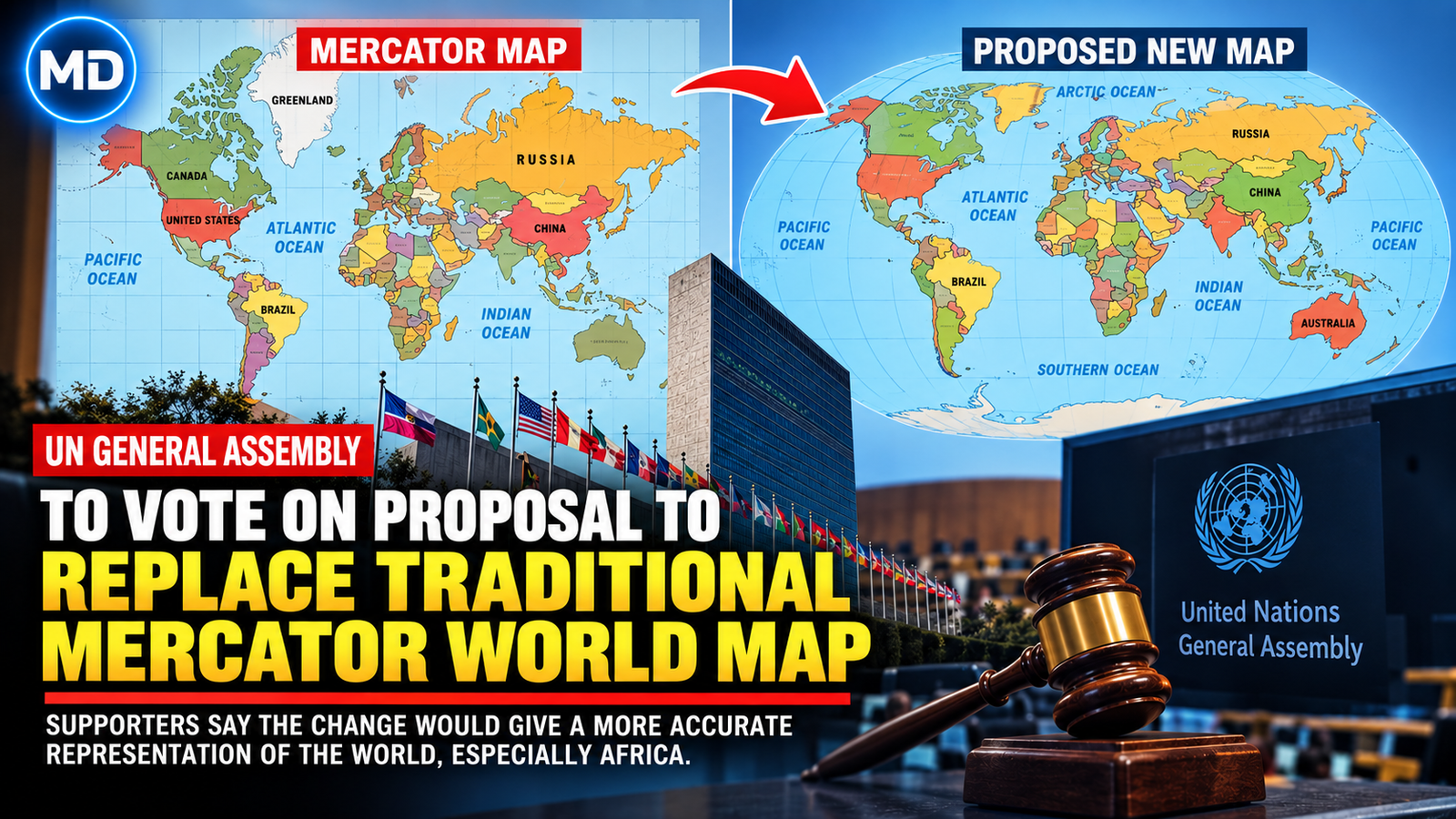
The United Nations General Assembly is scheduled to vote on Friday on a resolution proposing the global phase-out of the traditional Mercator world map in favor of a projection that accurately represents the size of Africa. The resolution was sponsored by Togo and supported by the other 54 member states of the African Union, according to Togolese Foreign Affairs Minister Robert Dussey.
Dussey emphasized that the proposal is rooted in scientific accuracy rather than politics. While UN resolutions are non-enforceable, a successful vote could influence educational curricula and modern technological applications, where the Mercator layout remains widely used.
Distortions in the Standard World Map
Created in 1569 by Flemish cartographer Gerardus Mercator to assist maritime navigation, the Mercator projection distorts landmasses by exaggerating high-latitude regions while shrinking areas near the equator. Under this projection, Africa appears roughly equivalent in size to Greenland, despite being 14 times larger than the Danish territory. Campaign materials from the #CorrectTheMap initiative note that Africa's true landmass can encompass the United States, China, India, Japan, Mexico, and much of Europe combined.
Historians, geographers, and activists have long criticized the Mercator map, arguing that its visual minimization of the global south reinforces Eurocentric bias and influences international perceptions, development priorities, and trade dynamics. German historian Arno Peters presented the Gall–Peters projection in 1973 as an alternative, but the current Togolese campaign advocates for the 2018 Equal Earth projection, created by an international team of cartographers.
Broader Context and Implementation Plans
The African Union officially endorsed the #CorrectTheMap campaign in August 2025, appointing Togo to lead the international diplomatic effort. Geopolitical analysts note that the campaign reflects a broader push by African countries for fairer representation and greater influence in global governance and institutions.
Togolese officials draw confidence from a similar diplomatic success in March, when a Ghana-sponsored resolution recognizing the slave trade as the "gravest crime against humanity" passed at the UN with 123 votes in favor, three against, and 52 abstentions. Following the upcoming vote, the Togolese government plans to host an event in Lomé during the first quarter of next year alongside UNESCO, the African Union, and technology companies including Google Maps to outline steps for adopting the updated map layout.
0 YORUMLAR
Bu KONUYA henüz yorum yapılmamış. İlk yorumu sen yaz...