
Cairo Mural Depicting Dark-Skinned Pharaohs Covered Up Following Online Backlash
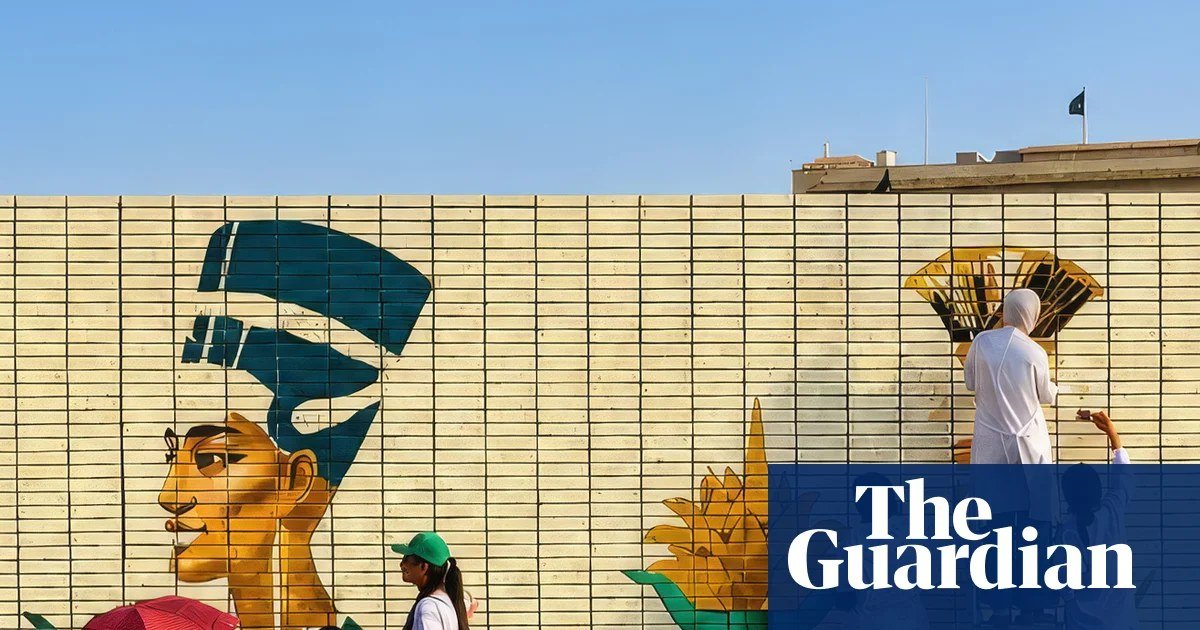
Cairo authorities ordered the painted removal of a 66-metre-long mural in Tahrir Square after its portrayal of ancient Egyptian pharaohs with dark skin ignited intense public controversy. The artwork, created by a youth volunteer group named Rasmet Basma, depicted King Tutankhamun and Queen Nefertiti. It was one of 40 murals commissioned to beautify the city ahead of a state visit by Chinese President Xi Jinping.
The backlash erupted over perceptions that the artwork supported Afrocentric theories regarding the origins of ancient Egypt's 14th-century BCE rulers. Hours before the Chinese president arrived in Cairo, municipal workers painted over the entire image. Ahmed Moussa, the 22-year-old founder of Rasmet Basma, confirmed that the Cairo governorate requested the team to cover up the piece, which had been produced over five days in late August.
AI Design and Public Reaction
According to Moussa, the volunteer team generated the original design using the artificial intelligence tool ChatGPT before painting it onto the wall. Local officials, including Cairo's deputy governor and the district head, initially visited the site and expressed approval. However, opinions shifted rapidly once social media users began criticizing the artwork's dark skin tones.
Moussa explained that the team applied a golden-bronze shade that created a shadow effect under night lighting, making the faces appear dark-skinned. He acknowledged that the group made a mistake by failing to consult art and archaeology specialists prior to executing the design. Social media critics questioned whether the painters were familiar with historical depictions of Nefertiti, while others expressed concern that Afrocentric movements would cite the public mural as an endorsement of their claims.
Expert Opinions on History and Technology
Afrocentrism is a political movement asserting that ancient Egyptian civilization was black African in its population and origin. Former Egyptian antiquities minister Zahi Hawass supported the public outrage, stating that non-experts should not have been permitted to paint in a location as prominent as Tahrir Square. Hawass dismissed assertions linking ancient Egyptian civilization to sub-Saharan Africa as unsupported, noting that historical temple carvings explicitly differentiate Egyptian kings from captives originating from parts of Africa, Syria, Libya, and Palestine.
Monica Hanna, an Egyptologist and assistant professor at the American University of Iraq–Baghdad, categorized Afrocentric claims as pseudoscience. She emphasized that Egyptian society has historically maintained diverse ethnic backgrounds, ranging from Mediterranean populations in the north to Nubian communities in the south, adding that Egyptians were never defined by a single skin color.
The incident also raised questions regarding the application of generative technology in public art. Walid Mahmoud, an AI researcher and African anthropology expert, noted that AI programs reflect dominant online trends rather than historical accuracy due to their development by Western tech companies. Art critic Mostafa Eissa cautioned against relying entirely on AI for artistic execution, arguing that human oversight remains essential to preserve artistic originality.
0 YORUMLAR
Bu KONUYA henüz yorum yapılmamış. İlk yorumu sen yaz...