
Airlink Defends Low-Altitude Stadium Flyby Before Rugby Test Match in Cape Town
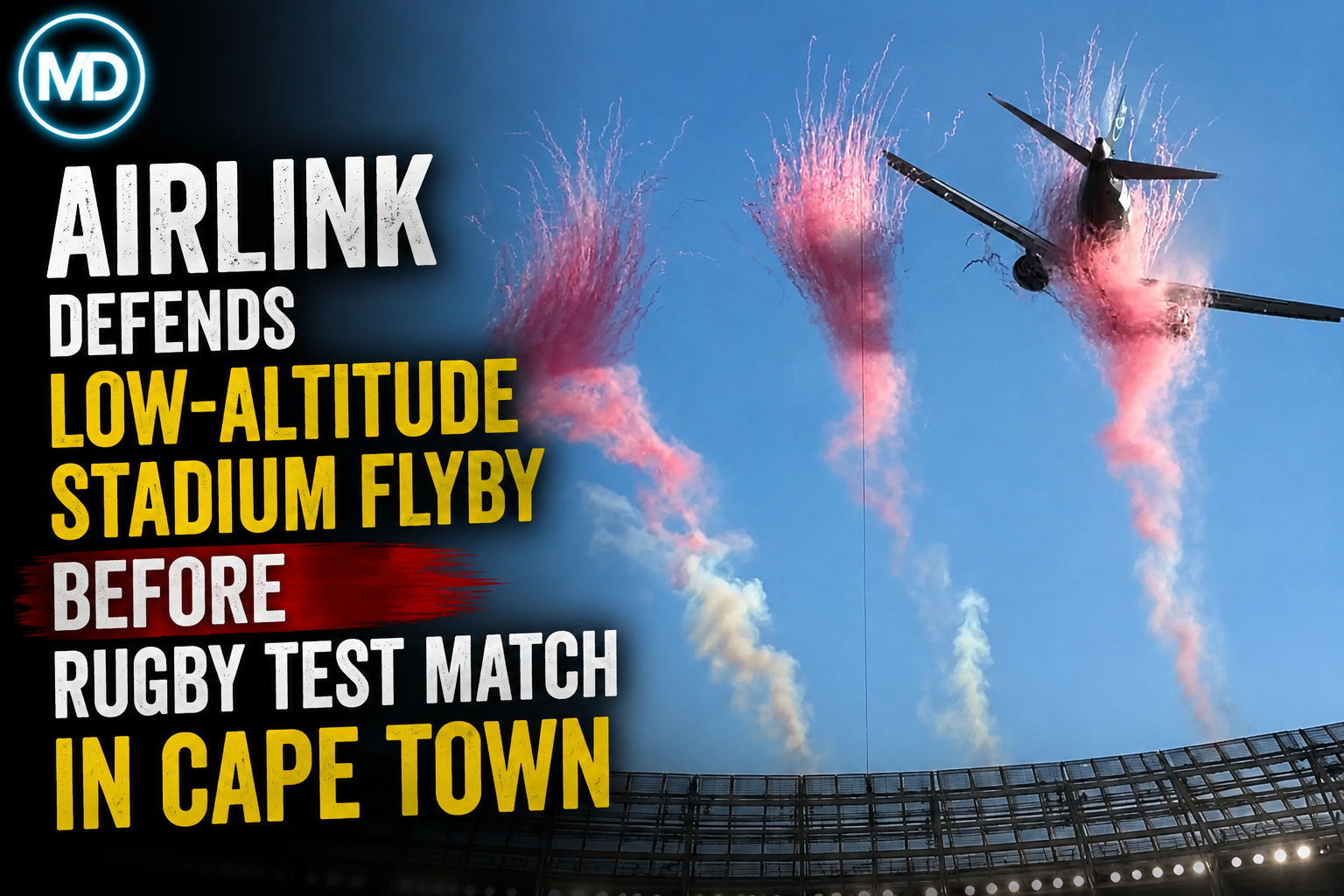
South African airline Airlink has defended a dramatic pre-game aviation stunt after two passenger jets executed an extremely low-level flyby over Cape Town Stadium prior to Saturday's rugby union Test match between South Africa and New Zealand. While the aerial display delighted a crowd of approximately 56,000 spectators, it has triggered significant debate among aviation safety experts regarding potential hazards.
Flight Path and Expert Safety Concerns
The demonstration involved two Embraer regional passenger jets flying in close formation over the venue. Flight tracking service Flightradar24 estimated that the lead aircraft cleared the stadium roof by just 41 to 46 feet (12 to 14 metres). A trailing second aircraft flew directly behind, passing through a cloud of pink dust released from the stadium roof as part of the entertainment sequence. Broadcast footage and witness videos quickly generated global attention following the event.
Aviation analysts raised concerns about the minimal margin for error during the low-altitude maneuver. Chris Martinus, president of the Aircraft Owners and Pilots Association South Africa, noted that the lead jet appeared to dodge over the roof, leaving pilots without recovery options if an adverse incident occurred at that height. Australian aviation consultant Keith Tonkin warned that Embraer passenger jets are not designed for low-level operations. Tonkin highlighted risks such as bird strikes or turbulence, cautioning that setting such a precedent could lead to dangerous outcomes in the future.
Airline Defense and Regulatory Compliance
Responding to online and social media scrutiny on Sunday, Airlink—a sponsor of the South African national rugby team—maintained that the operation fully complied with civil aviation safety regulations. The carrier stated that no passengers were aboard the aircraft and that the flight was meticulously planned and rehearsed at speeds of approximately 150 knots (172 mph).
Airlink highlighted that each jet was crewed by three senior captains fulfilling the roles of commander, co-pilot, and safety officer. According to the airline, the South African Civil Aviation Authority and Air Traffic Navigation Services provided guidance, approval, and support for the event. Airlink added that flight data recorded from both aircraft confirmed the maneuvers remained strictly within authorized civil aviation limits for speed and altitude. Low-altitude flybys before major rugby matches have been a tradition in South Africa since a Boeing 747 flew over Johannesburg's stadium prior to the 1995 World Cup final.
0 YORUMLAR
Bu KONUYA henüz yorum yapılmamış. İlk yorumu sen yaz...