
NASA Launches Nancy Grace Roman Space Telescope to Explore Dark Energy and Exoplanets
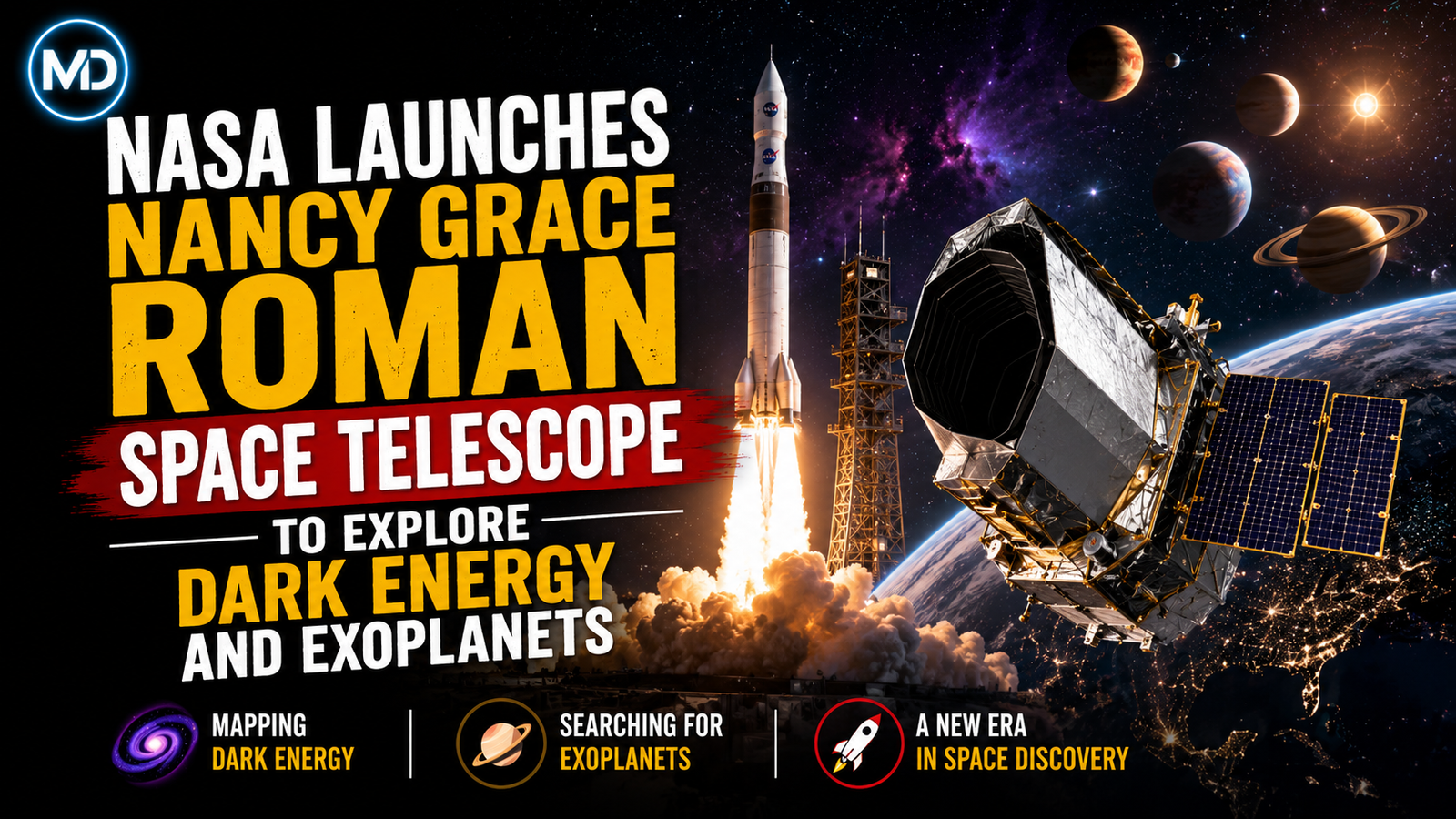
NASA has successfully launched its next-generation space observatory, the Nancy Grace Roman Space Telescope, from the Kennedy Space Center in Florida. Liftoff occurred on a Sunday morning local time aboard a SpaceX Falcon Heavy rocket. Approximately 30 minutes after launch, the spacecraft separated from the rocket to begin its 100-day journey to an orbit approximately one million miles from Earth.
A Major Step Forward in Astronomy
The observatory is designed to investigate dark energy, dark matter, black holes, and planets outside our solar system, known as exoplanets. According to NASA, the Roman telescope features a field of vision 100 times larger than both the Hubble and James Webb space telescopes. NASA Administrator Nicky Fox stated that the mission is expected to discover tens of thousands, or possibly up to 100,000, new exoplanets and help determine whether distant worlds could be habitable.
Following the launch, Roman project manager Jackie Townsend characterized the event as glorious, noting that the trajectory placed the spacecraft precisely where intended. U.S. President Donald Trump also phoned into NASA's post-launch news conference to offer congratulations to the mission team.
Mission Position and Objectives
The spacecraft will operate from a vantage point about one million miles away, four times further than the Moon's distance from Earth. Astronomer Jenifer Millard explained that this distant location prevents infrared light generated by the Earth and Moon from interfering with the telescope's infrared cameras. This positioning mirrors that of the James Webb Space Telescope, which launched in 2021 and also orbits roughly one million miles from Earth, whereas the Hubble Space Telescope operates much closer at about 300 miles above Earth's surface.
Researchers plan to use Roman's expansive view to assemble vast cosmic maps across different epochs of time. These maps aim to assist scientists in studying the effects and nature of dark matter—which acts as a gravitational glue—and dark energy, a repulsive force accelerating the expansion of the Universe. Combined, dark matter and dark energy are estimated to constitute roughly 95% of the Universe.
Honoring a Pioneer in Space Science
The telescope is named in honor of physicist Nancy Grace Roman (1925–2018), who served as NASA's first chief astronomer in the 1960s and was the agency's first female executive. Known as the "mother of Hubble" for her pivotal role in securing congressional approval for the Hubble Space Telescope, she previously noted that dark energy was Hubble's most intriguing discovery.
The Nancy Grace Roman Space Telescope has a primary mission lifespan of five years, with an operational goal of reaching 10 years.
0 YORUMLAR
Bu KONUYA henüz yorum yapılmamış. İlk yorumu sen yaz...